

The business at a glance
Registered users are platform accounts, not a GPU count. The network itself is powered by thousands of active GPUs.
Revenue sources
Pay-per-request compute
Developers and applications pay per request for AI jobs — text, image, video, embeddings, transcription.
Direct AI partnerships
Bulk compute agreements with AI projects, agencies and platform integrations.
Store margin
The GamerHash Store earns a margin on digital goods — games, game keys, gift cards, prepaid codes.
Where the revenue goes
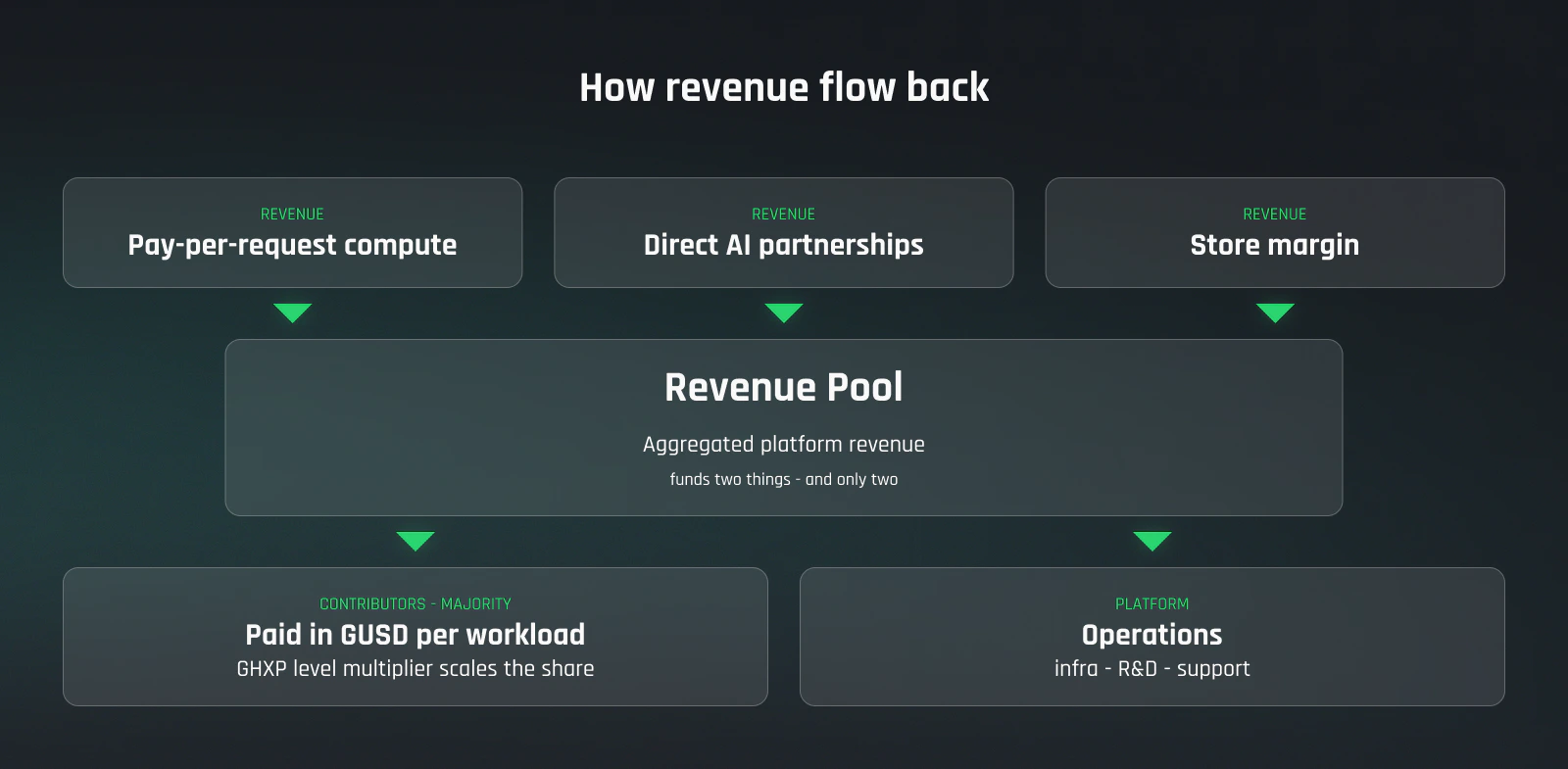
Payouts for GPU work
Every completed AI job credits the earnings balance of the machine that ran it, in GUSD.
Platform operations
Infrastructure, development and support — the cost of keeping the network running.
What buyers pay
Buyers pay per request. Access is one OpenAI-compatible REST API plus an official n8n node, so an application or an automation workflow can send AI jobs to the network without building infrastructure for it. 10,000+ developers are registered.What the people sharing GPU power get
You install the app and opt in; the app takes the jobs on its own. There is no queue to watch and nothing to accept by hand — this is passive income from a machine that is switched on anyway.- Earnings in GUSD — credited as AI jobs complete on your GPU. GUSD is counted 1:1 with the dollar inside the platform. It is not a token and not a stablecoin — it is an earnings balance in your account.
- Payout in the asset you choose — take the balance out as USDC to any BNB Chain address (a Binance deposit address, MetaMask on BSC, any BEP-20 wallet), or as GHX onchain on Ethereum, BNB Chain or Solana.
- Or spend it in the Store — 600+ digital items in the GamerHash Store: games, Steam keys, gift cards, prepaid codes.
Payouts leave the platform in crypto only — as USDC or as GHX. There is no transfer to a bank account.
Outside the revenue model
Two things sit next to the revenue model and are not paid for out of it:- The monthly season rewards. The GHX handed out each season is provided by GamerCoin under a cooperation arrangement — it is not funded from platform revenue. The activity points (GHXP) participants lock decide where each of them places in the season ranking, and each place carries a defined reward; none of it changes what a single AI job pays.
- GHX itself. The ecosystem token is documented and operated on its own site, outside the GamerHash AI platform.
Activity points (GHXP)
How points accrue every minute the app runs, and how a monthly season ranking pays out.
GamerCoin: token documentation ↗
GHX is documented and operated outside this platform.
Why the model holds up
Payouts are funded by what buyers pay for compute, not by issuing a token. What there is to distribute follows how much compute the network sells. Whether to spend the balance in the Store, take it out as USDC, or take it out as GHX is a separate decision from whether the machine is earning at all.Earnings depend on demand on the network. There is no fixed or promised rate.
Next
Earning model
What the app pays for and what determines how much a machine earns.
GamerHash Store
600+ digital items you can pay for with your earnings balance.
Wallets
What sits in your account, and how a payout leaves the platform.
Developer API
The buyer side — OpenAI-compatible REST plus an official n8n node.