> ## Documentation Index
> Fetch the complete documentation index at: https://docs.gamerhash.com/llms.txt
> Use this file to discover all available pages before exploring further.
# AI builders
> How developers and AI product teams use the GamerHash GPU network through deAPI.
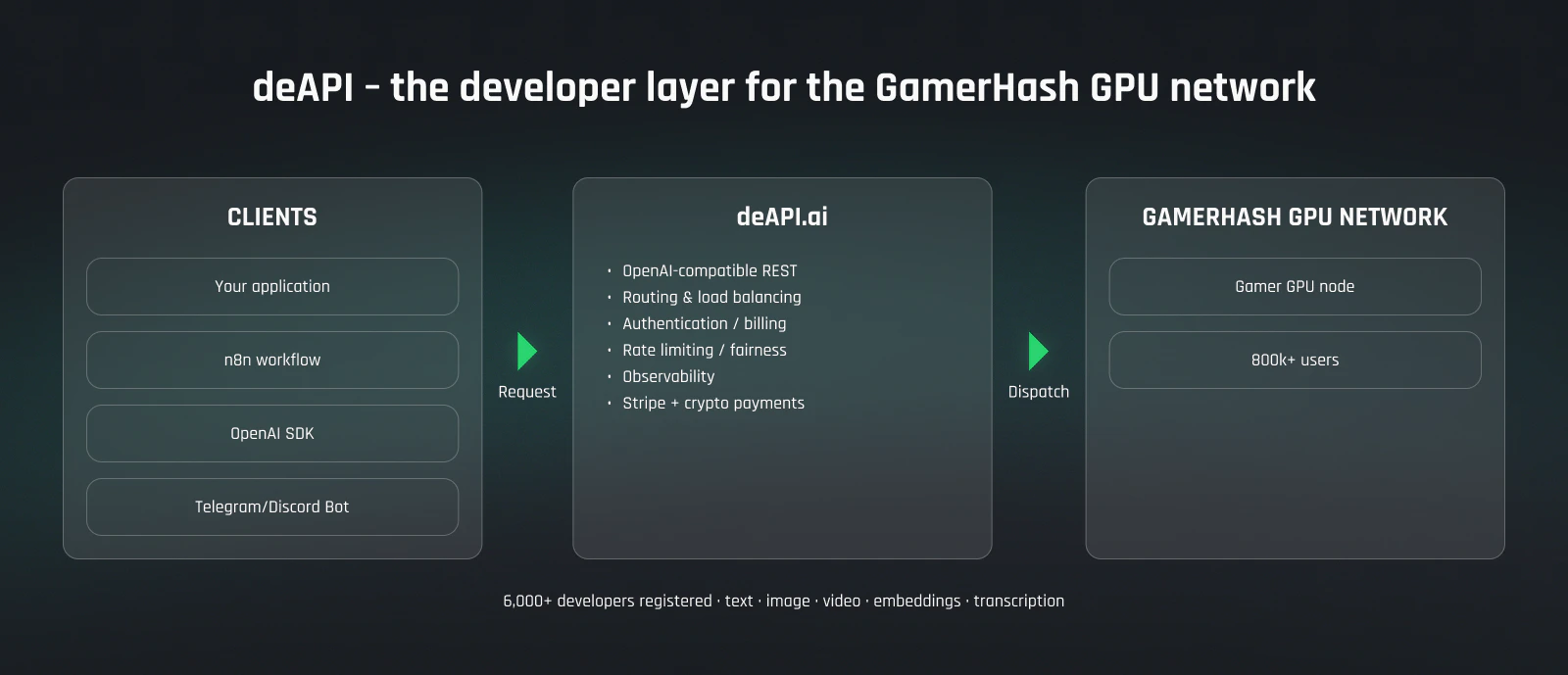
GPU contributors run hardware, gamers earn from the side. **AI builders are on the other end of the network** — they consume the compute. The product they use is **[deAPI](https://deapi.ai)**: an OpenAI-compatible REST endpoint that exposes the GamerHash GPU network to any application, workflow, or bot.
 ## Who this is for
* **App developers** wiring chat, image, or video generation into their products.
* **n8n / automation operators** who need cheap, private inference inside workflows.
* **Indie devs and agencies** building MVPs that need a backend without a cloud bill.
* **Web3 teams** combining on-chain logic with off-chain AI compute.
## What you get
* **OpenAI-compatible REST** — drop-in for code already using the OpenAI SDK. Change `base_url` and an API key; same chat completions, same streaming, same response shape.
* **Multi-modal coverage** — text-to-image, image edit, image / text / audio → video, voice (TTS + transcription), text-to-music, OCR, embeddings. One credential, every model class.
* **An official [n8n](https://n8n.io) node** — call the network from any n8n workflow without writing API code.
* **Routing & failover handled** — deAPI dispatches to whichever GPU is free, retries on transient failures, balances by model fit.
* **Cost transparency** — per-model pricing, live usage dashboard, budgets.
## Why deAPI vs. centralised clouds
* **Cost** — workloads run on consumer GPUs that would otherwise be idle. The unit economics are different from hyperscaler pricing.
* **Open-source models** — pick across Flux, LTX-Video, Qwen, Whisper, ACE-Step and more. No proprietary lock-in, no per-model rate-limit silos.
* **Privacy** — content is dispatched and discarded; the network does not retain prompts or outputs after settlement.
* **Real money to real users** — your spend funds the people running the GPUs, not a hyperscaler's margin.
## Trade-offs to be aware of
* **Latency** — consumer GPUs aren't co-located in a single datacentre. First-token latency is higher than a centralised cloud, especially for cold-start workloads.
* **Model availability** — the catalogue is curated and grows steadily, but isn't infinite. Niche or proprietary models may not be available.
* **Capacity** — at peak demand, queue times can extend. Standard rate limits apply.
## How it flows
A deAPI request hits a gateway, gets authenticated and billed, then dispatches across the network of contributor machines running the AI App. Every dollar that flows through is split between platform infrastructure and **direct contributor pay** in GUSD — the same loop that pays gamers and dedicated GPU contributors.
## Get started
Sign up, generate keys, view live usage.
The other side of the network — who runs the workloads you call.
## Who this is for
* **App developers** wiring chat, image, or video generation into their products.
* **n8n / automation operators** who need cheap, private inference inside workflows.
* **Indie devs and agencies** building MVPs that need a backend without a cloud bill.
* **Web3 teams** combining on-chain logic with off-chain AI compute.
## What you get
* **OpenAI-compatible REST** — drop-in for code already using the OpenAI SDK. Change `base_url` and an API key; same chat completions, same streaming, same response shape.
* **Multi-modal coverage** — text-to-image, image edit, image / text / audio → video, voice (TTS + transcription), text-to-music, OCR, embeddings. One credential, every model class.
* **An official [n8n](https://n8n.io) node** — call the network from any n8n workflow without writing API code.
* **Routing & failover handled** — deAPI dispatches to whichever GPU is free, retries on transient failures, balances by model fit.
* **Cost transparency** — per-model pricing, live usage dashboard, budgets.
## Why deAPI vs. centralised clouds
* **Cost** — workloads run on consumer GPUs that would otherwise be idle. The unit economics are different from hyperscaler pricing.
* **Open-source models** — pick across Flux, LTX-Video, Qwen, Whisper, ACE-Step and more. No proprietary lock-in, no per-model rate-limit silos.
* **Privacy** — content is dispatched and discarded; the network does not retain prompts or outputs after settlement.
* **Real money to real users** — your spend funds the people running the GPUs, not a hyperscaler's margin.
## Trade-offs to be aware of
* **Latency** — consumer GPUs aren't co-located in a single datacentre. First-token latency is higher than a centralised cloud, especially for cold-start workloads.
* **Model availability** — the catalogue is curated and grows steadily, but isn't infinite. Niche or proprietary models may not be available.
* **Capacity** — at peak demand, queue times can extend. Standard rate limits apply.
## How it flows
A deAPI request hits a gateway, gets authenticated and billed, then dispatches across the network of contributor machines running the AI App. Every dollar that flows through is split between platform infrastructure and **direct contributor pay** in GUSD — the same loop that pays gamers and dedicated GPU contributors.
## Get started
Sign up, generate keys, view live usage.
The other side of the network — who runs the workloads you call.