> ## Documentation Index
> Fetch the complete documentation index at: https://docs.gamerhash.com/llms.txt
> Use this file to discover all available pages before exploring further.
# Business model
> Where the revenue comes from, and how it flows back to contributors and the platform.
The platform earns when AI workloads run on the network. The same revenue funds two things: **contributor payouts** and **platform operations** — nothing else.
## Revenue sources
Developers and applications rent AI compute on demand — text, image, video, embeddings, transcription.
Bulk compute deals with AI projects, agencies, and platform integrations.
GamerHash Store earns a margin on digital goods — games, gift cards, vouchers.
GHX-gated features in the AI App (like AI Image Booster prompts) aren't a revenue source — they're holder benefits, unlocked by holding GHX, not by paying.
## How it flows back
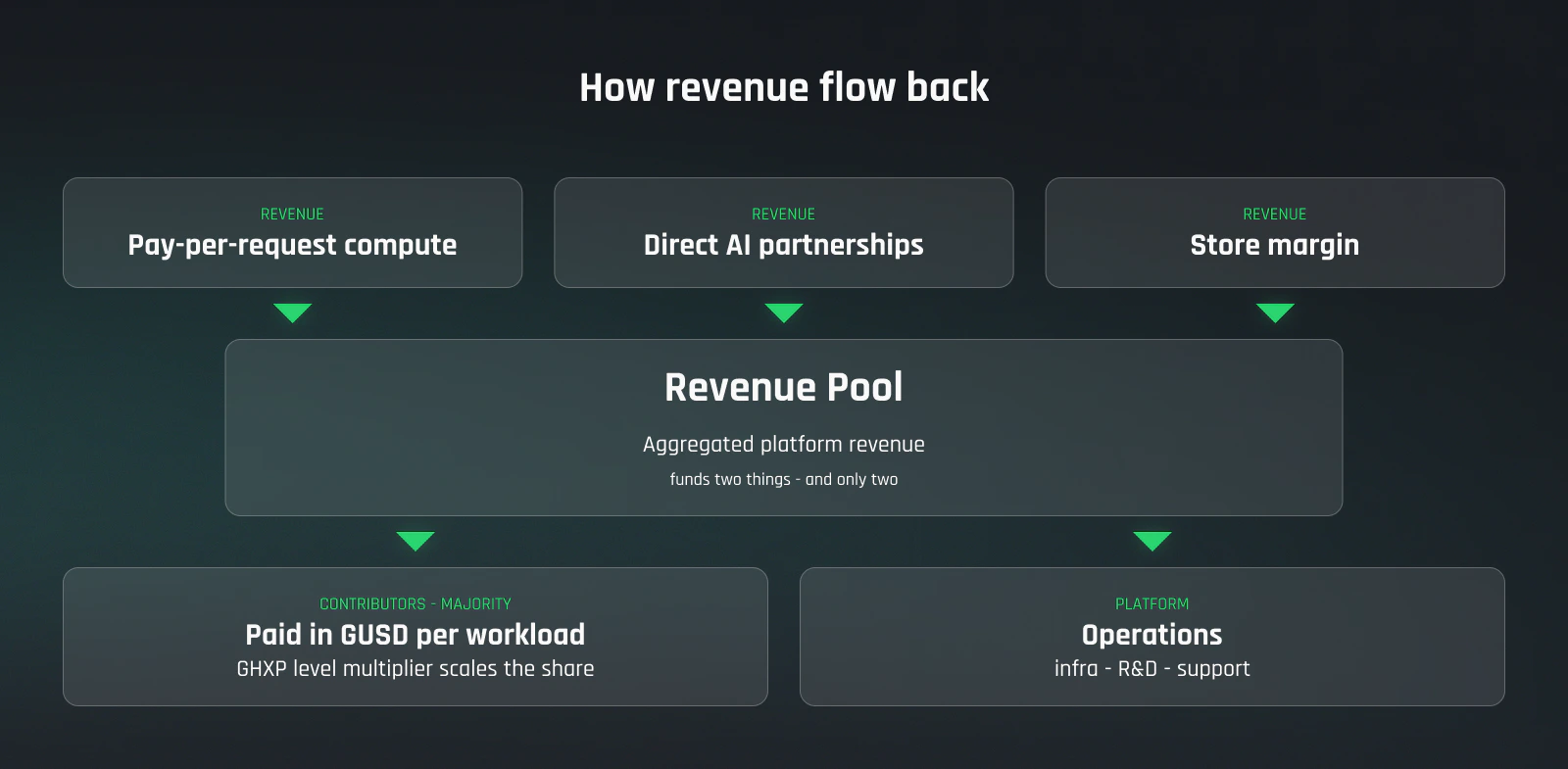 The split favors contributors — they own the GPUs doing the work. The platform takes the slice needed to keep the lights on (infra, R\&D, support), and that's it. After payout, GamerHash supports two integrated paths inside the platform:
* **Swap GUSD → GHX** — raises your AI App level, which accelerates GHXP accrual on top of regular earnings.
* **Withdraw GUSD → USDC** — straight to an external wallet (e.g., Binance), no intermediate steps.
For the token-side picture — supply, distribution, and staking — see the [GHX tokenomics docs](https://docs.gamercoin.com/tokenomics/overview).
## What contributors get
When you run the GamerHash AI App with the earning module enabled:
* **GUSD per workload** — credited automatically as jobs complete.
* **GHXP** — engagement points awarded every minute the app runs. Higher GHXP = higher reward share when revenue is distributed.
* **GHX boost** — holding GHX (in MetaMask or your in-app GHX wallet) multiplies your GHXP accrual rate, so token holders earn faster.
The earned GUSD is yours. Three things you can do with it:
* **Convert to GHX** — hold, or stake for up to **25% APR** at [staking.gamercoin.com](https://staking.gamercoin.com).
* **Withdraw as USDC** — straight to Binance, no intermediate steps.
* **Spend in the GamerHash Store** — games, gift cards, prepaid digital goods.
## What buyers pay
Pricing is per-request, by model class. One credential covers chat completions, image generation, video, embeddings, and transcription — same access pattern, every model class. Bulk and partner pricing is negotiated case-by-case.
## Why this works
The model is unusual in that **rewards are paid in GUSD, the platform's internal earning currency, not in token emissions**. Mining rewards from a fixed pool shrink as more people join; here, the more compute the network sells, the larger the pool that gets distributed. As long as compute demand grows, contributor earnings grow with it — there's no built-in dilution curve.
It also means contributors don't need to speculate on token price to get paid. Whether to hold the earned GUSD, swap to GHX (raises AI App level), stake, or withdraw as USDC is a separate decision from whether the work is earning at all.
## Further reading
How GHX ties into the AI revenue flywheel — utility, supply, and where the token sits in the stack.
Why the same idle-GPU thesis pays better as AI inference than as PoW hashes.
## Next
GUSD, GHXP, levels, and what determines per-machine yield.
How the multiplier works and why holding GHX matters.
The split favors contributors — they own the GPUs doing the work. The platform takes the slice needed to keep the lights on (infra, R\&D, support), and that's it. After payout, GamerHash supports two integrated paths inside the platform:
* **Swap GUSD → GHX** — raises your AI App level, which accelerates GHXP accrual on top of regular earnings.
* **Withdraw GUSD → USDC** — straight to an external wallet (e.g., Binance), no intermediate steps.
For the token-side picture — supply, distribution, and staking — see the [GHX tokenomics docs](https://docs.gamercoin.com/tokenomics/overview).
## What contributors get
When you run the GamerHash AI App with the earning module enabled:
* **GUSD per workload** — credited automatically as jobs complete.
* **GHXP** — engagement points awarded every minute the app runs. Higher GHXP = higher reward share when revenue is distributed.
* **GHX boost** — holding GHX (in MetaMask or your in-app GHX wallet) multiplies your GHXP accrual rate, so token holders earn faster.
The earned GUSD is yours. Three things you can do with it:
* **Convert to GHX** — hold, or stake for up to **25% APR** at [staking.gamercoin.com](https://staking.gamercoin.com).
* **Withdraw as USDC** — straight to Binance, no intermediate steps.
* **Spend in the GamerHash Store** — games, gift cards, prepaid digital goods.
## What buyers pay
Pricing is per-request, by model class. One credential covers chat completions, image generation, video, embeddings, and transcription — same access pattern, every model class. Bulk and partner pricing is negotiated case-by-case.
## Why this works
The model is unusual in that **rewards are paid in GUSD, the platform's internal earning currency, not in token emissions**. Mining rewards from a fixed pool shrink as more people join; here, the more compute the network sells, the larger the pool that gets distributed. As long as compute demand grows, contributor earnings grow with it — there's no built-in dilution curve.
It also means contributors don't need to speculate on token price to get paid. Whether to hold the earned GUSD, swap to GHX (raises AI App level), stake, or withdraw as USDC is a separate decision from whether the work is earning at all.
## Further reading
How GHX ties into the AI revenue flywheel — utility, supply, and where the token sits in the stack.
Why the same idle-GPU thesis pays better as AI inference than as PoW hashes.
## Next
GUSD, GHXP, levels, and what determines per-machine yield.
How the multiplier works and why holding GHX matters.